Climate Change
India's Water Revolution: Blending Ancient Wisdom with Future Tech
From 'Catch the Rain' to 'Paagal Saab': How India is Securing its Urban Water Future, One Drop at a Time
# India's Water Revolution: Blending Ancient Wisdom with Future Tech\n\n## From 'Catch the Rain' to 'Paagal Saab': How India is Securing its Urban Water Future, One Drop at a Time\n\n**By Environment Warrior Staff**\n\n**New Delhi, India – July 26, 2026** – As the world grapples with escalating climate change impacts, water scarcity remains one of the most pressing challenges, particularly in rapidly urbanizing nations. India, a country often at the forefront of environmental innovation and traditional wisdom, is charting an ambitious and multi-faceted course to secure its urban water future. Today, exactly two years after the launch of several landmark initiatives, the nation stands as a beacon of hope, demonstrating how a blend of ancient practices, scientific ingenuity, and robust community engagement can truly transform the water landscape. \n\nThe urgency is undeniable.
With burgeoning populations and erratic monsoon patterns, India's cities face immense pressure on their water resources. Groundwater, the lifeline for millions, has seen alarming depletion. Recognizing this critical juncture, the Government of India has doubled down on its commitment, expanding its Urban Groundwater Recharge Programme to a staggering 75 cities. This bold move, championed by Minister of State for Housing and Urban Affairs, Tokhan Sahu, under the umbrella of the 'Catch the Rain' campaign and AMRUT 2.
0, is not just a policy shift; it’s a cultural reawakening. \n\n## The 'Catch the Rain' & AMRUT 2. 0 Synergy: A National Imperative\n\nAt the heart of India's urban water strategy lies the powerful synergy between the 'Catch the Rain' campaign and AMRUT 2. 0 (Atal Mission for Rejuvenation and Urban Transformation).
These initiatives are more than just government mandates; they are a clarion call for collective action. During a recent review meeting at Sankalp Bhawan, New Delhi, Minister Sahu underscored the vision: "India’s water-conservation strategy must seamlessly integrate scientific innovation with the profound traditional knowledge developed by communities over generations. " This philosophy is now guiding efforts across the nation to enhance water conservation and urban water management. \n\nThe expansion of the groundwater recharge programme to 75 cities is a monumental undertaking.
It signifies a paradigm shift from reactive crisis management to proactive, sustainable resource augmentation. The focus is clear: capture every raindrop, replenish aquifers, and build urban resilience against water stress. This is being achieved through a combination of large-scale infrastructure projects and decentralized, community-driven interventions, all meticulously planned and executed with expert guidance from bodies like the National Institute of Urban Affairs (NIUA). \n\n## Resurrecting Ancient Wisdom: The Guardians of Traditional Water Bodies\n\nWhile modern engineering offers powerful solutions, India's rich heritage of water management systems provides an invaluable blueprint.
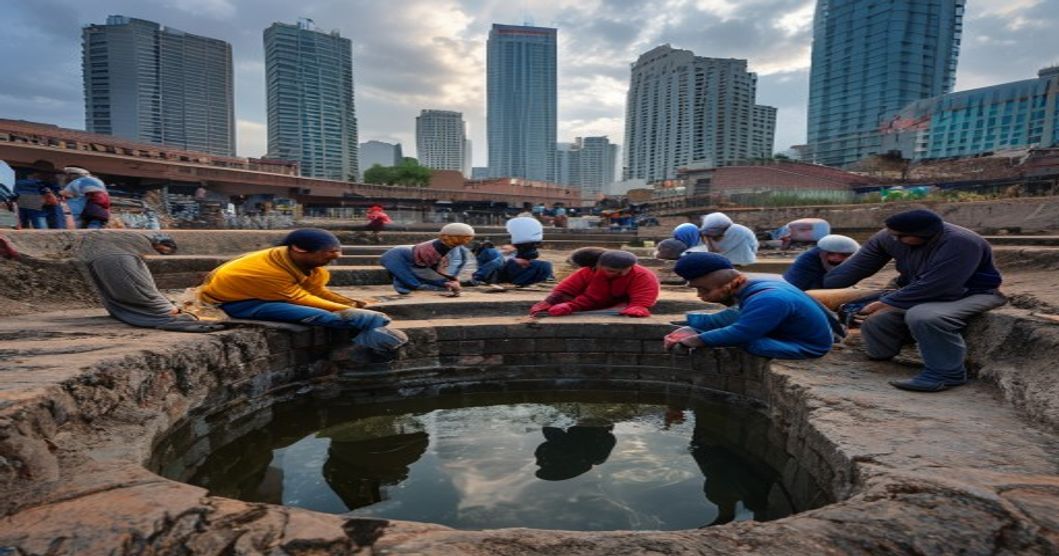
Across the subcontinent, ancient civilizations perfected techniques for rainwater harvesting, storage, and groundwater recharge through structures like stepwells (bawris), ponds (kulams), and community tanks (jhalaras). The 'Catch the Rain' campaign actively promotes the revival and restoration of these traditional water bodies, recognizing their ecological and historical significance. \n\nOne of the most inspiring tales in this revival comes from Jodhpur, Rajasthan, where an 80-year-old Irishman, Caron Rawnsley, affectionately known as 'Paagal Saab' (Mad Sir) by locals, has dedicated a decade of his life to cleaning and restoring the city's forgotten bawris and jhalaras. His tireless, almost obsessive, mission began after being captivated by Rajasthan's architectural marvels as a tourist.
Today, his selfless passion has not only brought these magnificent structures back to life but has also inspired countless others, earning praise from figures like Anand Mahindra. Rawnsley's work is a living testament to the power of individual commitment in preserving heritage and ensuring sustainable water management. \n\nSimilarly, in Puducherry, the restoration of Muzhiyan Kulam in Pooranankuppam village stands as another shining example. Inaugurated by Union Finance Minister Smt.
Nirmala Sitharaman, this project was a collaborative effort involving Lumina Datamatics, Dhanasundarambal Charitable Society, local community stakeholders, and public representatives. The objective was clear: revive a traditional water body to strengthen water conservation efforts in the region. These instances highlight that the journey towards water security is as much about looking forward with innovation as it is about looking back to wisdom passed down through generations. \n\n## Embracing Modern Innovation: Beyond the Traditional\n\nWhile traditional methods are being revitalized, India is equally committed to integrating cutting-edge scientific innovation into its water management strategy.
The emphasis is on smart, sustainable solutions that optimize resource use and minimize environmental impact. Groundwater recharge, for instance, is not just about digging ponds; it involves hydrological surveys, advanced filtration systems, and real-time monitoring to ensure efficiency and water quality. \n\nBeyond direct water conservation, India is also exploring synergistic innovations. A prime example is Gujarat's pioneering canal-top solar power project.
This ingenious initiative not only generates renewable energy without consuming valuable farmland but also significantly reduces water evaporation from the canals – saving an impressive 9 million liters of water annually. While not directly part of the groundwater recharge programme, such projects exemplify India's holistic approach to resource management, demonstrating how diverse environmental challenges can be tackled with integrated, multi-benefit solutions. This forward-thinking approach ensures that water conservation is woven into the broader fabric of sustainable development. \n\n## The Power of Community: Incentivizing Change from the Ground Up\n\nNo policy, however well-intentioned, can succeed without the active participation of its citizens.
The 'Catch the Rain' campaign places community involvement at its core, recognizing that water conservation is a shared responsibility. India's cities are increasingly empowering residents to become active 'water warriors' through innovative incentives and awareness campaigns. \n\nIndore, consistently ranked as India's cleanest city, has taken a commendable lead in this regard. Mayor Pushyamitra Bhargav recently announced a significant incentive: homeowners can now slash their property tax bills by 10% by installing and maintaining functional rainwater harvesting systems.
This initiative is a game-changer, turning environmental responsibility into tangible financial benefit. Requiring inspection and certification by the Municipal Corporation, the rebate is contingent on the system's continued operation, ensuring long-term impact. It’s a win-win, offering financial savings to residents while substantially boosting groundwater recharge and water conservation efforts across the city. Such localized, incentive-based models are crucial for scaling up sustainable practices rapidly.
\n\n## Challenges and the Path Forward: A Resilient Future\n\nDespite these remarkable strides, the path to universal urban water security is fraught with challenges. Rapid urbanization continues to put pressure on infrastructure, climate change introduces unpredictable weather patterns, and the sheer scale of the population demands sustained effort. However, India's current trajectory, spearheaded by visionary leadership and empowered communities, offers a blueprint for resilience. \n\nThe holistic approach – combining national campaigns like 'Catch the Rain' and AMRUT 2.
0, the restoration of traditional water bodies, the adoption of modern scientific techniques, and the active engagement of citizens through incentives – demonstrates a mature and comprehensive strategy. The ongoing review by Minister Sahu and his team, involving officials from the AMRUT Mission and NIUA, ensures that these programmes remain dynamic, adaptive, and effective. \n\n## Conclusion: India - A Global Leader in Sustainable Water Management\n\nAs of July 26, 2026, India is not just addressing its water crisis; it is redefining what sustainable urban water management looks like on a global scale. From the bustling metropolises to the quiet villages, a water revolution is underway – one that respects the wisdom of the past, embraces the innovation of the present, and builds a secure, water-rich future for generations to come.
The stories of 'Paagal Saab', the restored kulams, the canal-top solar projects, and Indore's pioneering tax rebates are not isolated incidents; they are threads in a vibrant tapestry of a nation committed to becoming a true 'Environment Warrior' in the fight for water security. \n\nIt is a testament to India's spirit that amidst the complexities, it finds strength in its diverse heritage and its people's collective will. The journey is long, but with every drop conserved, every aquifer recharged, and every community mobilized, India moves closer to its vision of a water-secure future.